
In Vivo Gamete Toxicology in the Context of In Vitro Fertilization: A Narrative Review

A peer-reviewed narrative review published in F&S Reviews, Volume 6, Issue 1, June 2025, examining the role of environmental toxicology in impairing in vivo fertility and gamete quality prior to IVF treatment. The review evaluates how pre-IVF exposure to environmental contaminants — including heavy metals, per- and polyfluoroalkyl substances (PFAS), persistent organic pollutants, and airborne contaminants including VOCs — may impair gamete potential and downstream IVF success rates. The authors provide a comprehensive reference of toxicological exposures for IVF clinicians, drawing on in vitro, animal, and human correlative data to identify potential causative mechanisms and strengthen the case for routine patient toxicological risk assessment before IVF treatment. Published in F&S Reviews, Volume 6, Issue 1, June 2025. DOI: 10.1016/j.xfnr.2025.100090. Authors: Orsolini, M.; Russack, J.; Huynh, H.; Raburn, D.; Fox, J.; Schust, D.

Predicting Airborne Volatile Organic Compound Transport in Highly Sensitive In Vitro Processes and Biopharmaceutical Manufacturing Facilities with Kinetic Models

A peer-reviewed study published in Applied In Vitro Toxicology, Volume 11, Issue 4, 2025, presenting kinetic models for predicting the transport of airborne volatile organic compounds into cell culture systems in highly sensitive in vitro processes and biopharmaceutical manufacturing facilities. Building on prior equilibrium partitioning modeling work, this study addresses a fundamental knowledge gap regarding the rate of VOC partitioning into cell cultures — critical for understanding how airborne contamination affects both IVF embryo culture outcomes and cell and gene therapy manufacturing processes. The models demonstrate how VOC transport rates from ambient air into culture media can be predicted and managed, with direct implications for air quality standards in IVF laboratories and biopharmaceutical cleanrooms. Published in Applied In Vitro Toxicology, Volume 11, Issue 4, 2025. Authors: Russack, J.S.; Fox, J.T.; Huynh, H.T.; Worrilow, K.C.; Brown, D.G.

advanced air purification technology clinical outcomes healthcare settings

The clinical and environmental effects of an advanced air purification technology in multiple healthcare settings

A peer-reviewed study published in Science and Technology for the Built Environment examining the clinical and environmental effects of LifeAire’s advanced air purification technology across multiple healthcare settings — an acute care hospital and a long-term care facility. The study synthesizes environmental and clinical outcome data from both settings, demonstrating that LifeAire’s multi-stage system, designed to inactivate the genetic material of all airborne pathogens and remediate volatile organic compounds, produced consistent, measurable improvements across both facility types. Originally presented at the 2022 ASHRAE Annual Conference in Toronto. Published in Science and Technology for the Built Environment, Volume 29, Issue 9, October 2023. DOI: 10.1080/23744731.2023.2266349. Authors: Urrutia, A.R.; Stawicki, S.P.; Kimble, C.N.; Worrilow, K.C.

Clinical and Economic Outcomes from the Installation of an Advanced Air Purification Technology in a Long Term Care Facility

A peer-reviewed short commentary published in the Journal of Gerontology and Geriatric Medicine examining the clinical and economic outcomes of LifeAire’s advanced air purification technology in a long-term care facility over 15 months. The study compared LifeAire’s multi-stage system — combining VOC filtration, high-dose UV germicidal irradiation, and HEPA filtration — against standard HEPA filtration in a memory support unit. Documented outcomes included a 98.83% reduction in airborne pathogens, an 89.88% reduction in VOC levels, a 39.6% reduction in facility-acquired infections, and a 47% reduction in staff call-outs. The findings demonstrate meaningful improvements in resident wellness, safety, and facility economics. Published in Journal of Gerontology and Geriatric Medicine, July 2023. DOI: 10.24966/GGM-8662/100177. Authors: Urrutia, A.R.; Eid, S.; Bock, K.A.; Worrilow, K.C.

Clean Room Technology in ART Clinics: A Practical Guide

A practical reference book on clean room technology in assisted reproductive technology clinics, co-authored by Dr. Kathryn C. Worrilow, Founder and Chief Scientific Officer of LifeAire Systems, alongside Sandro C. Esteves and Alex C. Varghese. The book addresses the design, implementation, and management of controlled environments in IVF and ART laboratories, with coverage of air quality standards, VOC contamination control, particulate management, and the environmental factors that directly influence embryo culture outcomes and clinical success rates. Drawing on Dr. Worrilow’s more than 20 years of IVF laboratory directorship and her foundational research into the impact of ambient air on human embryogenesis, the book serves as a comprehensive resource for embryologists, laboratory directors, and ART clinic administrators seeking to optimize their facility’s environmental standard. Published via Amazon. Authors: Esteves, S.C.; Varghese, A.C.; Worrilow, K.C.

air purification environmental clinical outcomes long-term care facility

The Effects of an Advanced Air Purification Technology on Environmental and Clinical Outcomes in a Long-Term Care Facility

A peer-reviewed, IRB-approved study examining the impact of LifeAire’s advanced air purification technology on environmental and clinical outcomes in a long-term care memory support facility over a 15-month period. The study compared a LifeAire-protected unit with a HEPA-only control unit on the same floor, measuring airborne and surface pathogen burden, facility-acquired infection rates, and staff absenteeism. Documented outcomes in the LifeAire-protected unit included an 89.1% reduction in airborne pathogens, an 88.9% reduction in surface pathogens, a 39.6% reduction in facility-acquired infections, and a 47% reduction in staff call-outs. The findings confirm that advanced air purification delivers measurable improvements in both clinical outcomes and operational performance in long-term care environments. Published in The Journals of Gerontology: Series A, Volume 78, Issue 12, 2023. Authors: Urrutia, A.R.; Schlener, S.D.; Eid, S.; Bock, K.A.; Worrilow, K.C.

air purification hospital-acquired infections length of stay healthcare economics

Proven Impact of an Advanced Air Purification System in the Reduction of Infectious Airborne and Surface Pathogens, Concomitant Reduction of Hospital-acquired Infections and Length of Stay, and Improvement in Health-care Economics

A peer-reviewed, IRB-approved operational clinical study examining the impact of LifeAire’s advanced air purification technology on airborne and surface pathogen burden, hospital-acquired infection rates, patient length of stay, and healthcare economics. Conducted at St. Luke’s University Health Network, the study compared a LifeAire-protected unit with a HEPA-only control unit over 12 months across 8,255 patients. Documented outcomes in the protected unit included a 99.99% reduction in viable airborne pathogens, a 97% reduction in surface pathogens, a 30% reduction in hospital-acquired infections, a 39% reduction in patient length of stay, and a 23% improvement in per-bed economics. Published in the Journal of Global Infectious Diseases, March 2023.

air purification technology environmental clinical metrics healthcare settings

The Effects of Air Purification Technology on Environmental and Clinical Metrics in Two Healthcare Settings

A peer-reviewed, IRB-approved post-hoc synthesis of two independent clinical studies examining the impact of LifeAire’s advanced air purification technology on environmental and clinical metrics in two healthcare settings: an acute care hospital medical-surgical floor and a long-term care memory support unit. Both facilities showed significant reductions in airborne and surface bacterial and fungal pathogens and VOC levels. The hospital demonstrated a 39.5% reduction in patient length of stay and 23% cost savings. The long-term care facility showed a 39.6% reduction in facility-acquired infections and a 47% reduction in staff call-outs. Published in ASHRAE Transactions, Volume 128, Part 2, June 2022. Authors: Worrilow, K.C.; Stawicki, S.P.; Schlener, S.D.; Urrutia, A.R.; Kimble, C.N.

Modeling the equilibrium partitioning of low concentrations of airborne volatile organic compounds in human IVF laboratories

A peer-reviewed study published in Reproductive BioMedicine Online examining the equilibrium partitioning behavior of volatile organic compounds at low concentrations in human IVF laboratory environments. Using mathematical modeling, the study investigates how airborne VOCs at trace concentrations distribute between the gas phase and biological media including culture media and embryonic cells, demonstrating the potential for molecular-level chemical contamination of the embryo culture environment. The findings support the clinical rationale for comprehensive VOC remediation in IVF laboratories as a necessary component of embryo protection. Published in Reproductive BioMedicine Online, May 2022. Authors: Fox, J.T.; Ni, P.; Urrutia, A.R.; Huynh, H.T.; Worrilow, K.C.

germicidal ultraviolet light inactivate coronavirus N95 respirator PPE

Effectiveness of germicidal ultraviolet light to inactivate coronavirus on personal protective equipment to reduce nosocomial transmission

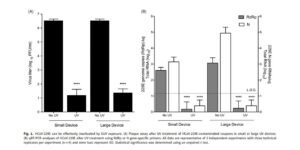
A peer-reviewed laboratory study published in Infection Control and Hospital Epidemiology examining the effectiveness of germicidal ultraviolet light to inactivate human coronaviruses on N95 respirators, supporting safe PPE reuse. Researchers tested two commercially available portable GUV devices — including a LifeAire Systems unit — against three coronaviruses: HCoV-229E, HCoV-OC43, and SARS-CoV-2. GUV treatment achieved average viral titer reductions of 5-log for HCoV-229E, 3-log for HCoV-OC43, and 5-log for SARS-CoV-2 on respirator surfaces. The findings confirm that LifeAire’s GUV technology is effective at decontaminating N95 respirators from human coronaviruses, supporting its potential to reduce nosocomial transmission. Published in Infection Control and Hospital Epidemiology, June 2021. Authors: Camargo, C.; Lupien, A.; McIntosh, F.; Menzies, D.; Behr, M.A.; Sagan, S.M.