
When hospital and clinical leaders first encounter LifeAire, one of the most common questions they ask is a reasonable one: we already have HEPA filtration throughout our facility. How does LifeAire fit with that?
It is exactly the right question. And the answer is not that one replaces the other. The answer is that they were designed to do different things, and that understanding what each one does, and does not do, is the foundation of a genuinely comprehensive clinical air protection strategy.
WHAT HEPA DOES EXCEPTIONALLY WELL
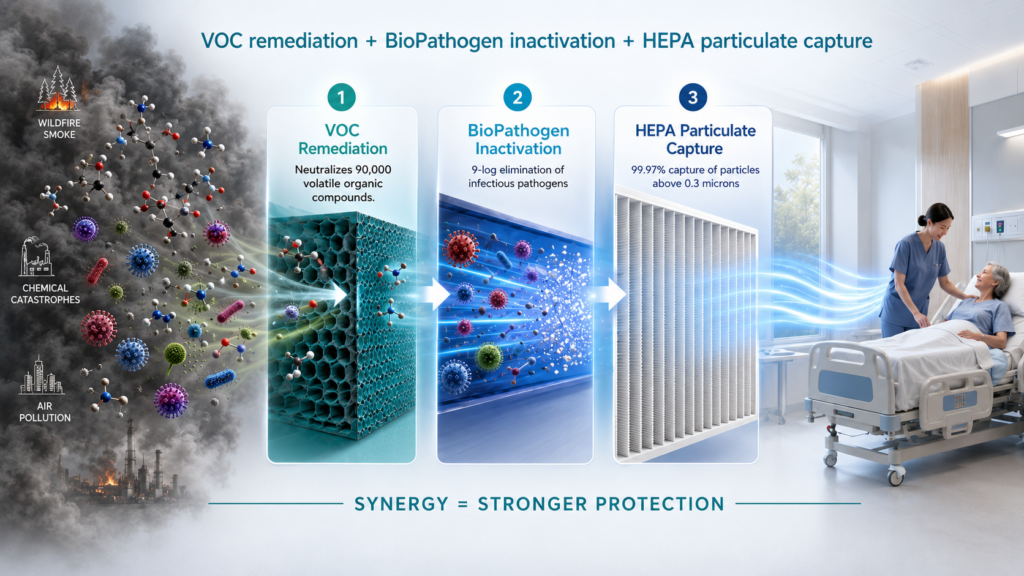
HEPA filtration is one of the most effective particulate capture technologies ever developed. It was originally engineered during the Manhattan Project to prevent radioactive particulate from escaping into occupied air environments. That origin explains a lot about its design: it was built to trap particles, and it does that with extraordinary precision, capturing 99.97% of airborne particles above 0.3 microns on a single pass.
In a clinical environment, that particulate capture capability is genuinely valuable. Dust, dander, pollen, larger biological particles: HEPA removes them from the air stream reliably and consistently. It is the foundational layer of air quality management in most hospital HVAC systems, and it deserves that status. There is a reason it has been the clinical standard for decades.
HEPA is also well understood, well maintained, and deeply integrated into the regulatory and compliance frameworks that govern hospital facility management. Facilities teams know how to specify it, install it, maintain it, and validate it. It is a known quantity in an environment where known quantities carry significant value.
WHERE HEPA’S DESIGN HAS LIMITS
The limits of HEPA are not failures. They are simply the boundaries of what it was designed to do. Understanding them is not a criticism of HEPA. It is the starting point for understanding what a complete air protection strategy requires.
HEPA captures particles. It does not kill the organisms those particles carry. A viable pathogen retained on a HEPA filter does not stop being viable. Under certain conditions, including pressure differentials, filter changes, and airflow variations, organisms that have been captured can re-enter the air stream. The filter is a repository, not a kill zone.
HEPA does not address volatile organic compounds. VOCs are molecular-level chemical contaminants generated continuously by disinfectants, building materials, plastics, device components, and human occupancy. They are smaller than the particles HEPA is designed to capture, and they pass through HEPA media without any interaction. In clinical environments, particularly NICUs, oncology units, transplant floors, and IVF laboratories, VOC burden adds a chemical dimension to the contamination environment that HEPA cannot manage.
HEPA also provides protection only through the air change cycle. Between passes through the filter, the clinical space is unprotected. In a room with standard hospital air change rates, the interval between full air treatment cycles is long enough that continuously introduced contamination, from patient movement, staff activity, and procedure-related aerosol generation, remains in the air between cycles.
These are not arguments against HEPA. They are descriptions of what it was designed to do and where additional protection is needed.
HOW LIFEAIRE COMPLETES THE PICTURE
LifeAire’s multi-stage technology was designed specifically to address the dimensions of clinical air protection that HEPA leaves unaddressed. It does not duplicate what HEPA already does well. It builds on it.
Where HEPA captures particles, LifeAire adds active pathogen kill, achieving a 9-log (99.9999999%) elimination of infectious biological pathogens in a single pass through the system. The organisms that HEPA would retain on its filter media, LifeAire inactivates before they ever reach the filter. The viable pathogen load entering the clinical space is reduced to near zero before any filtration is required.
Where HEPA passes VOCs through without capture, LifeAire’s molecular media filtration stage neutralizes them, reducing total VOC burden to below 50 parts per billion. This addresses the chemical contamination dimension that particle-based filtration cannot reach, protecting patients and staff from the invisible chemical load that accumulates in every occupied clinical environment.
And where HEPA provides protection cyclically through the air change rate, LifeAire provides protection continuously. Every unit of air is fully treated before it enters the clinical space. There is no between-cycle interval during which room air is unprotected. The protection is real-time, constant, and independent of the air change rate.
Together, HEPA and LifeAire deliver something neither can deliver alone: comprehensive protection from both the biological and chemical dimensions of clinical air contamination, continuously, without the gaps that either system would leave on its own.
WHAT THIS LOOKS LIKE IN PRACTICE
At St. Luke’s University Health Network’s Allentown campus, the LifeAire-protected unit operates alongside the facility’s existing HVAC infrastructure, including its HEPA filtration system. The LifeAire system adds the active kill, the VOC neutralization, and the continuous real-time protection that the HVAC and HEPA infrastructure alone cannot provide.
The outcome data from that installation, a 99.99% reduction in viable airborne pathogens, a 97% reduction in surface pathogens, a 39% reduction in patient length of stay, and a 23% improvement in per-bed economics, documented in a peer-reviewed study of 8,255 patients published in the journal Surgery, reflects what the combined system delivers. Not LifeAire alone. Not HEPA alone. Both working together in a layered clinical air protection strategy.
That is the model. HEPA does what it does best: reliable, validated, compliant particulate capture integrated into the facility’s HVAC infrastructure. LifeAire does what HEPA cannot: active pathogen kill, VOC neutralization, and continuous real-time protection of the clinical space.
The result is not a replacement. It is a completion.
For hospital leaders who want to understand what a combined air protection strategy would look like in their specific facility, the right starting point is an Aire~Analysis air quality assessment at lifeaire.com/air-quality-consultation. The published clinical research is at lifeaire.com/resources. The complete guide to air quality as a continuous infection control platform is at lifeaire.com/infection-control-air-purification-platform.
ABOUT THE AUTHOR
Eric J. Aulicino is Chief Executive Officer of LifeAire Systems, leading the company’s global commercial strategy and market expansion across hospital, IVF, life sciences, and long-term care markets. He brings more than three decades of global executive leadership including 25 years of international experience in Europe, China, and India. Full biography: lifeaire.com/eric-aulicino