
Unseen Adversaries: The Critical Impact of Airborne Pathogens on Healthcare Safety and Economics

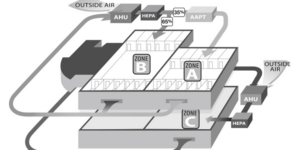
A LifeAire Systems white paper examining the critical impact of airborne pathogens on healthcare safety and economics. The paper reviews the $28.4 billion annual cost of healthcare-associated infections in the United States, the limitations of HEPA filtration as a capture-only strategy that does not neutralize pathogens or eliminate VOCs, and the paradigm shift represented by ASHRAE 241: Control of Infectious Aerosols — which establishes new standards for single-pass pathogen inactivation that LifeAire’s technology meets and surpasses. The paper presents comparative environmental data showing 1,778 cfu/m3 viable biological pathogens and 1,372 ppb chemical contamination in HEPA-only clinical environments versus less than 1 cfu/m3 biological and less than 100 ppb chemical in HEPA plus LifeAire-purified environments. Includes study design details from the St. Luke’s Allentown 12-month hospital study, long-term care outcomes, and ASHRAE publication references. Published by LifeAire Systems, 2026.

LifeAire Systems protected 14 patient rooms over 12 months and delivered $2.3M in savings

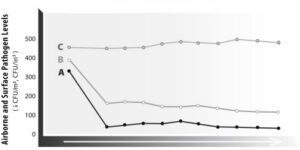
A LifeAire Systems case summary presenting the financial and clinical outcomes from a 12-month air purification study conducted at St. Luke’s University Health Network in Allentown, Pennsylvania. LifeAire’s advanced air purification system was installed in a 14-room medical-surgical unit and compared against a matched HEPA-only control unit across 8,255 patients. Documented outcomes included a 99.99% reduction in viable airborne pathogens, a 97% reduction in surface pathogens, a 39.5% reduction in patient length of stay, a trending reduction in hospital-acquired infections, and $2.3 million in total documented savings in a single year from a system costing less than $125,000 fully installed. The underlying peer-reviewed data was published in the journal Surgery, September 2020. Published by LifeAire Systems, January 2026.

Aire~IRMU™ – VOC Removal Testing Data

Independent third-party testing data documenting the volatile organic compound removal performance of the LifeAire Aire~IRMU In-Room Modular Air Purification Unit. The Aire~IRMU delivers LifeAire’s proven multi-stage purification technology — including molecular media VOC neutralization, UV pathogen kill, and HEPA filtration — in a compact, plug-and-play format requiring no HVAC integration. This testing data validates the VOC remediation capability of the Aire~IRMU for facilities and clinical environments where in-duct systems are not practical, including patient rooms, clinic spaces, senior living environments, and IVF laboratories. Published by LifeAire Systems, January 2026.

advanced air purification technology clinical outcomes healthcare settings

The clinical and environmental effects of an advanced air purification technology in multiple healthcare settings

A peer-reviewed study published in Science and Technology for the Built Environment examining the clinical and environmental effects of LifeAire’s advanced air purification technology across multiple healthcare settings — an acute care hospital and a long-term care facility. The study synthesizes environmental and clinical outcome data from both settings, demonstrating that LifeAire’s multi-stage system, designed to inactivate the genetic material of all airborne pathogens and remediate volatile organic compounds, produced consistent, measurable improvements across both facility types. Originally presented at the 2022 ASHRAE Annual Conference in Toronto. Published in Science and Technology for the Built Environment, Volume 29, Issue 9, October 2023. DOI: 10.1080/23744731.2023.2266349. Authors: Urrutia, A.R.; Stawicki, S.P.; Kimble, C.N.; Worrilow, K.C.

air purification hospital-acquired infections length of stay healthcare economics

Proven Impact of an Advanced Air Purification System in the Reduction of Infectious Airborne and Surface Pathogens, Concomitant Reduction of Hospital-acquired Infections and Length of Stay, and Improvement in Health-care Economics

A peer-reviewed, IRB-approved operational clinical study examining the impact of LifeAire’s advanced air purification technology on airborne and surface pathogen burden, hospital-acquired infection rates, patient length of stay, and healthcare economics. Conducted at St. Luke’s University Health Network, the study compared a LifeAire-protected unit with a HEPA-only control unit over 12 months across 8,255 patients. Documented outcomes in the protected unit included a 99.99% reduction in viable airborne pathogens, a 97% reduction in surface pathogens, a 30% reduction in hospital-acquired infections, a 39% reduction in patient length of stay, and a 23% improvement in per-bed economics. Published in the Journal of Global Infectious Diseases, March 2023.

air purification technology environmental clinical metrics healthcare settings

The Effects of Air Purification Technology on Environmental and Clinical Metrics in Two Healthcare Settings

A peer-reviewed, IRB-approved post-hoc synthesis of two independent clinical studies examining the impact of LifeAire’s advanced air purification technology on environmental and clinical metrics in two healthcare settings: an acute care hospital medical-surgical floor and a long-term care memory support unit. Both facilities showed significant reductions in airborne and surface bacterial and fungal pathogens and VOC levels. The hospital demonstrated a 39.5% reduction in patient length of stay and 23% cost savings. The long-term care facility showed a 39.6% reduction in facility-acquired infections and a 47% reduction in staff call-outs. Published in ASHRAE Transactions, Volume 128, Part 2, June 2022. Authors: Worrilow, K.C.; Stawicki, S.P.; Schlener, S.D.; Urrutia, A.R.; Kimble, C.N.

Economic Effects of Air Purification Technology on Healthcare-Acquired Infection Costs: A Study of Simulated Implementation across Low-and-Middle-Income Regions of the Globe

A peer-reviewed study published in the International Journal of Academic Medicine examining the economic effects of advanced air purification technology on healthcare-acquired infection costs through simulated implementation across low- and middle-income regions of the globe. The study models the potential financial impact of deploying LifeAire-class air purification technology in healthcare facilities across diverse economic contexts, demonstrating the broader global applicability of the infection control and cost reduction outcomes documented in U.S.-based clinical studies. Published in International Journal of Academic Medicine, Volume 7, 2021, pages 285-286. Authors: Kelley, K.C.; Schlener, S.D.; Levicoff, L.; Stawicki, S.P.

Installation of an Advanced Air Purification System in a Hospital Setting Led to Improved Environmental and Clinical Outcomes

A peer-reviewed study published in RenaRum examining the environmental and clinical effects of installing LifeAire’s advanced air purification system in a hospital setting. The study measured changes in airborne and surface pathogen burden, volatile organic compound levels, and clinical outcome metrics following LifeAire installation, contributing to the growing body of peer-reviewed operational evidence supporting advanced air purification as a clinical intervention in acute care hospital environments. Published in RenaRum, 2021. Authors: Johansson, L.; Urrutia, A.R.; Huynh, H.; Worrilow, K.C.

comprehensive air purification patient length of stay hospital economics

The impact of comprehensive air purification on patient duration of stay, discharge outcomes, and health care economics: A retrospective cohort study

A peer-reviewed, IRB-approved retrospective cohort study examining the impact of comprehensive air purification on patient length of stay, discharge outcomes, and healthcare economics at St. Luke’s University Health Network. The study compared 8,255 patients across a LifeAire-protected medical-surgical unit and a HEPA-only control unit over 12 months. Documented outcomes in the LifeAire-protected unit included a 39.5% reduction in patient length of stay, improved discharge metrics, and 23% cost savings per patient bed. The study confirms a direct relationship between advanced air purification and measurable improvements in both clinical and economic hospital performance. Published in Surgery, September 2020. Authors: Stawicki, S.P.; Wolfe, S.; Brisendine, C.; Eid, S.; Zangari, M.; Ford, F.; Snyder, B.; Moyer, W.; Levicoff, L.; Burfeind, W.R.

The Impact of Comprehensive and Live Air Purification on Health Resource Utilization (HRU)​

A conference abstract presented at the Academic Surgical Congress examining the impact of comprehensive and live air purification on health resource utilization in an acute care hospital setting. The abstract presents findings from the St. Luke’s University Health Network research team — the same team whose full 12-month retrospective cohort study of 8,255 patients was subsequently published in the journal Surgery in September 2020. The data examines the relationship between advanced air purification and measurable improvements in patient length of stay, discharge outcomes, and healthcare economics. Presented at the Academic Surgical Congress, 2020. Authors: Wolfe, S.; Brisendine, C.; Levicoff, L.; Eid, S.; Zangari, M.; Ford, F.; Snyder, B.; Moyer, W.; Stawicki, S.P.